bruceine D


| Name | Bruceine D | ||
| PubChem CID | 441788 | ||
| Molecular Weight | 410.4g/mol | ||
| Synonyms |
bruceine D |
||
| Formula | C₂₀H₂₆O₉ | ||
| SMILES | CC1=CC(=O)C(C2(C1CC3C45C2C(C(C(C4(C(C(=O)O3)O)O)(OC5)C)O)O)C)O | ||
| InChI | 1S/C20H26O9/c1-7-4-9(21)13(23)17(2)8(7)5-10-19-6-28-18(3,14(24)11(22)12(17)19)20(19,27)15(25)16(26)29-10/h4,8,10-15,22-25,27H,5-6H2,1-3H3/t8-,10+,11+,12+,13+,14-,15-,17-,18+,19+,20+/m0/s1 | ||
| InChIKey | JBDMZGKDLMGOFR-KQSRGDCESA-N | ||
| CAS Number | 21499-66-1 | ||
| ChEMBL ID | CHEMBL4759543 | ||
| ChEBI ID | CHEBI:68931 | ||
| KEGG ID | C08752 | ||
| Structure | 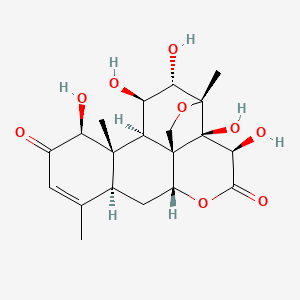
|
Download
2D
MOL
3D
MOL
|
|
| Chineses Pinyin | YaDanZi | ||
| Use Part | Fruit | ||
| Habitat | FuJian, GuangXi, YunNan, TaiWan, GuangDong, FuJian, TaiWan | ||
| Flavor | Bitter | ||
| Meridian Tropism | Large Intestine; Liver | ||
| Species |
>Kingdom: Viridiplantae
-->Phylum: Streptophyta
-->Class: Equisetopsida
-->Order: Sapindales
-->Family: Simaroubaceae
-->Genus: Brucea
-->Species: Brucea javanica
|
||
| Pair Name | Bruceine D, Gemcitabine | |||
| Partner Name | Gemcitabine | |||
| Disease Info | [ICD-11: 2C10.0] | Pancreatic ductal adenocarcinoma | Investigative | |
| Biological Phenomena | Inhibition-->Cell proliferation | |||
| Gene Regulation | Down-regulation | Expression | NFE2L2 | hsa4780 |
| Down-regulation | Expression | KEAP1 | hsa9817 | |
| Down-regulation | Expression | HMOX1 | hsa3162 | |
| Down-regulation | Expression | NQO1 | hsa1728 | |
| Down-regulation | Expression | AKR1B10 | KEGG ID N.A. | |
| Down-regulation | Expression | ABCC1 | hsa4363 | |
| Down-regulation | Expression | ABCC5 | KEGG ID N.A. | |
| In Vitro Model | PANC-1 | Pancreatic ductal adenocarcinoma | Homo sapiens (Human) | CVCL_0480 |
| Capan-2 | Pancreatic ductal adenocarcinoma | Homo sapiens (Human) | CVCL_0026 | |
| MIA PaCa-2 | Pancreatic ductal adenocarcinoma | Homo sapiens (Human) | CVCL_0428 | |
| In Vivo Model | Capan-2, control non-specific shRNA (shControl) or Nrf2-targeting shRNA (shNrf2)-transfected Miapaca-2 cells (1.5×10⁶ cells/100 μL) were injected into the pancreatic tail of each nude mouse. | |||
| Result | Our experimental findings indicate that BD, a potent Nrf2 inhibitor, holds promise for further development into a novel adjuvant therapy for PDAC. | |||
